
Why Your Memories Are Fading and How to Save Them The Tragedy of the Invisible Archive

We are the most photographed generation in human history. Every second, millions of shutters click, capturing birthdays, sunsets, and the fleeting expressions of our loved ones. Yet, we are standing on the precipice of becoming the "Lost Generation." Our memories are no longer kept in cedar chests or leather-bound albums; they are trapped in the "Digital Ether"—a fragile graveyard of pixels waiting for a power failure to vanish forever.
The irony of the 21st century is that while we have the tools to capture everything, we have lost the will to preserve anything. Your photos are currently living as mathematical code on a spinning disk or a remote server. If you don't act, your grandchildren won't find a box of photos in the attic; they will find a dead hard drive and a forgotten password to a defunct cloud service.
Raw, "imperfect" photography—featuring natural skin textures, motion blur, or candid expressions—has become the ultimate signal of trust and authenticity. This shift toward the "Unfiltered Era" proves that a grainy, emotional snapshot often converts better than a sterile studio portrait because it feels human.
The Fragility of the Pixel: Why Digital is Not Forever Digital storage is a promise often broken. We treat "The Cloud" as a permanent sanctuary, but in reality, it is a commercial lease that expires the moment a credit card is declined or a company changes its Terms of Service. Consider the wolves at the door of your digital library: Bit Rot & Hardware Failure: Hard drives have a 100% failure rate over a long enough timeline. Magnetic platters degrade, and SSD cells lose their charge. Digital Obsolescence: Remember floppy disks? CD-ROMs? Even the JPEG format will one day be replaced by something unrecognizable to future operating systems. The Subscription Trap: Your family history should not be held hostage by a monthly fee. If the service shuts down or you lose access to your account, decades of life vanish in a click. The Paradox of Abundance: When you have 50,000 photos on a phone, you effectively have none. They become "noise," buried under screenshots and memes, never to be revisited.
The Pigment on Paper Revolution: Engineering Eternity
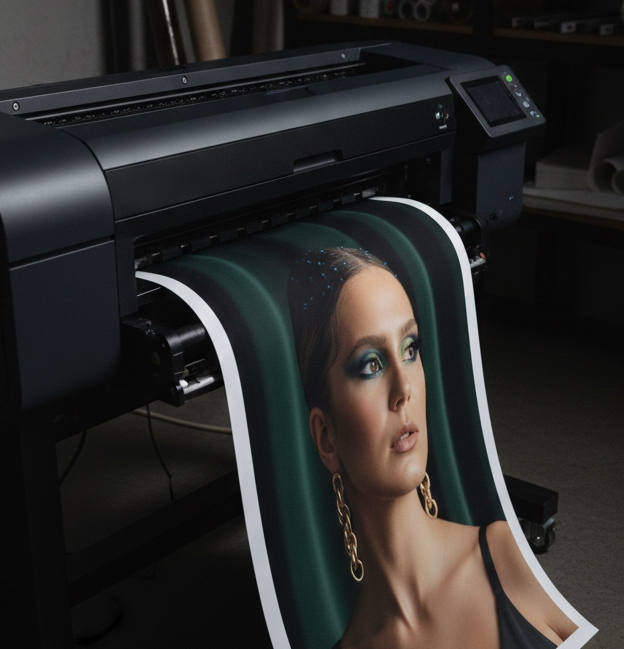
The antidote to this digital decay is the Archival Fine Art Print. As a master printer, I don't just "print" images; I translate light into a physical object. Unlike a standard "photo lab" print—which uses unstable dyes and acidic papers that yellow and fade within a decade—a professional pigment print utilizes mineral-based inks. When these micro-pigments are embedded into 100% acid-free cotton rag or alpha-cellulose paper (like those from Hahnemühle or Canson), we create a medium with a lifespan of 100 to 200 years. Why Fine Art Printing is Superior: Material Integrity: These papers are made from the same fibers used in museum-grade canvases and banknotes. They do not crumble; they endure. Chromatographic Depth: Pigment inks offer a "D-max" (black density) that digital screens cannot replicate, creating a sense of three-dimensional space. Tactile Connection: There is a psychological shift when you hold a photo. The weight of the paper and the texture of the grain transform a "file" into an "heirloom."
From Screen to Soul: The Sensory Experience A digital image is a ghost; it has no shadow, no weight, and no scent. A Fine Art print, however, appeals to the senses. It commands attention. When you hang a large-format, baryta-paper portrait on your wall, the way the light hits the texture of the paper changes throughout the day. It lives with you. It becomes part of the architecture of your home and the fabric of your identity. In the darkroom of the modern age, the computer is just the beginning. The final act of photography is—and always has been—the print. It is the moment an image becomes "real."
Your Legacy Starts Today Don't let your life’s work become digital dust. I challenge you to look through your library tonight. Find that one image—the one that makes your heart skip, the one that captures the essence of someone you love—and commit it to paper. Give your memories a body. Print them. Frame them. Ensure that 100 years from now, someone can hold your life in their hands and remember.
"A photograph is not a photograph until it is printed."